
 Wildlife
of Romania
Great Egret
Herons, Storks, Ibises & Pelicans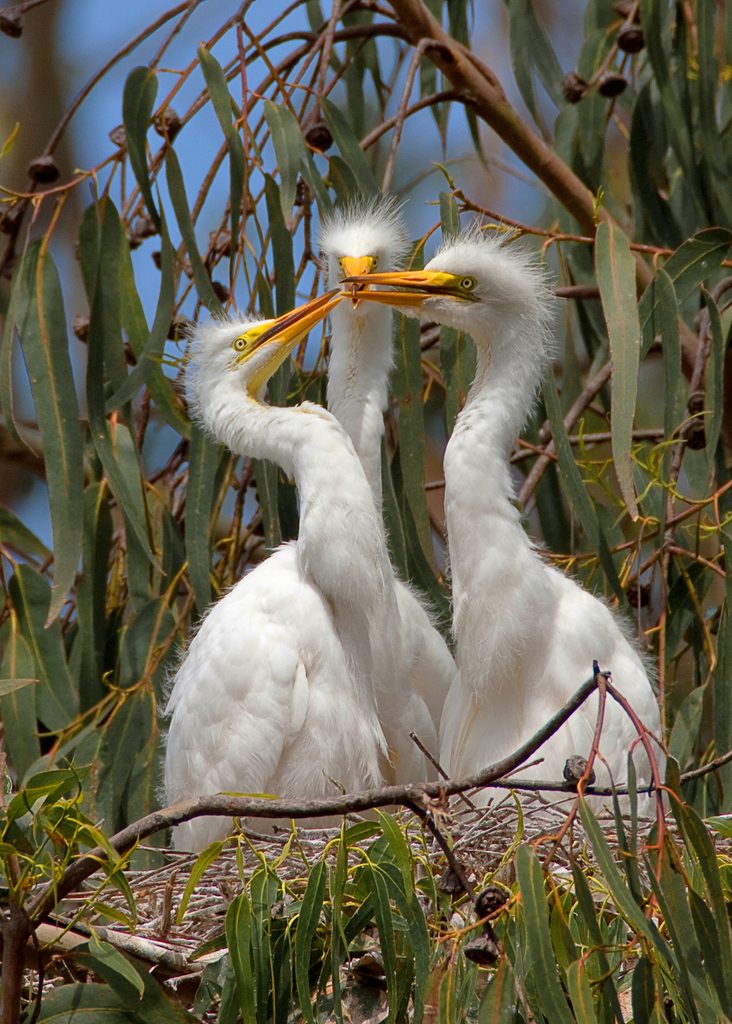
Photo: Mike Baird · CC BY 4.0 (May be cropped or resized)
Ardea alba
Basic stats
Diet
Fish, amphibians, small vertebrates, crustaceans and insects
Habitat
Freshwater and coastal wetlands, with breeding colonies usually near water
Range
Tropical and warmer temperate regions across Asia, Africa, Europe and the Americas
Clutch size
Usually 3 eggs
Incubation period
About 23 days
Size
80–104cm
Wingspan
131–170cm
Weight
Averages about 871g
Across its extensive range, the Great Egret is a tall, entirely white heron of tropical and warmer temperate wetlands in Asia, Africa, Europe and the Americas. Its long yellow bill, black legs and feet, and gape extending behind the eye help distinguish it from smaller white egrets; breeding birds grow fine ornamental plumes, and the bill can darken. It flies slowly with the neck folded back, as herons characteristically do. (Wikipedia, general species account)
The species hunts in shallow water and sometimes drier ground, taking fish, frogs, other small vertebrates, crustaceans and insects. Breeding birds gather in colonies and place stick nests in trees near lakes, reedbeds or other substantial wetlands. Both parents incubate and later feed the young by regurgitation; a typical clutch is three eggs, with incubation averaging about 23 days. Across datasets, its mass averages about 871.3 g. (Wikipedia, general species account; AnAge; AVONET, Tobias et al. 2022)
Where to see Great Egret in Romania
GBIF records grouped by protected area. They show where the species has been reported, not that it is there now, and they are not population counts.
Recorded in 11 protected areas (1876–2026). The 8 with the most records:
- Danube Delta Biosphere Reserve: 2,270 records (1876–2026)
- Balta Albă - Amara - Jirlău: 108 records (2012–2026)
- Mestecănișul de la Reci și Bălțile de la Ozun-Sântionlunca: 45 records (2020–2026)
- Parcul Natural Comana: 33 records (2012–2026)
- Iron Gates Natural Park: 22 records (2018–2025)
- Munții Almăjului - Locvei: 13 records (2018–2024)
- Munții Făgăraș: 9 records (2016–2024)
- Letea Forest: 7 records (2015–2024)
Quick answers
- What does the Great Egret eat?
- Fish, amphibians, small vertebrates, crustaceans and insects
- What habitat does the Great Egret live in?
- Freshwater and coastal wetlands, with breeding colonies usually near water
- Where is the Great Egret found?
- Tropical and warmer temperate regions across Asia, Africa, Europe and the Americas
- How many eggs does the Great Egret lay?
- Usually 3 eggs
- How long are the eggs of the Great Egret incubated?
- About 23 days
- How big is the Great Egret?
- 80–104cm
- What is the wingspan of the Great Egret?
- 131–170cm
- How much does the Great Egret weigh?
- Averages about 871g