 Wildlife
of Romania
Yellowhammer
Finches, Sparrows & Buntings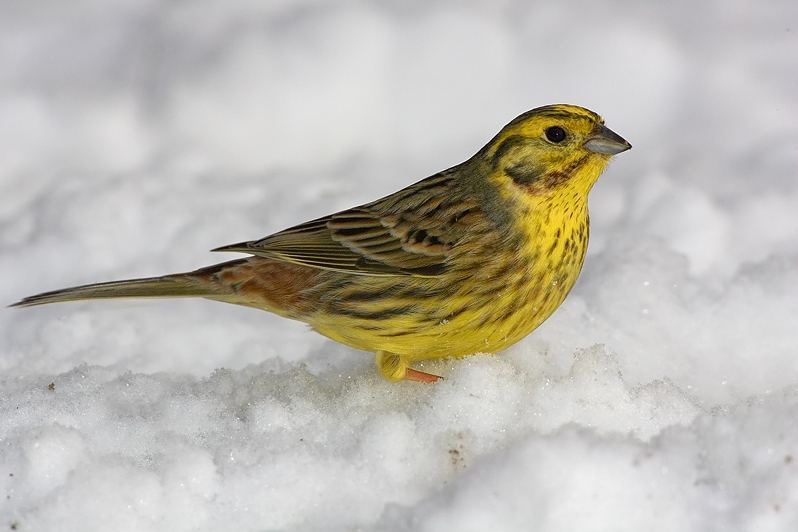
Photo: Martin Mecnarowski (http://www.photomecan.eu/) · CC BY-SA 3.0 (May be cropped or resized)
Emberiza citrinella
Basic stats
Diet
Mostly seeds, with invertebrates
Habitat
Open farmland, scrub, hedgerows and woodland edge
Range
Europe and western to central Asia; introduced to Australia and New Zealand
Clutch size
3–5 eggs
Incubation period
12–14 days
Size
16–16.5cm
Wingspan
23–29.5cm
Weight
Averages about 30g
At 16–16.5 cm long and 23–29.5 cm across the wings, the Yellowhammer is a relatively large bunting. Males have a bright yellow head and underparts, a streaked brown back, chestnut rump and white outer tail feathers; females and juveniles are duller and more heavily streaked. AVONET records an average mass of about 30 g (Wikipedia, general species account; AVONET, Tobias et al. 2022).
Native across Europe and western to central Asia and introduced to Australia and New Zealand, it favours open farmland, scrub, hedgerows and woodland edge. Birds feed on the ground, often flocking outside breeding. Seeds dominate the diet, while invertebrates become important during nesting. The female builds a concealed cup on or near the ground, lays three to five eggs and incubates them for 12–14 days (Wikipedia, general species account; EltonTraits, Wilman et al. 2014).
Where to see Yellowhammer in Romania
GBIF records grouped by protected area. They show where the species has been reported, not that it is there now, and they are not population counts.
Recorded in 14 protected areas (1912–2026). The 8 with the most records:
- Mestecănișul de la Reci și Bălțile de la Ozun-Sântionlunca: 95 records (2016–2026)
- Trascău: 72 records (2000–2024)
- Danube Delta Biosphere Reserve: 49 records (1994–2024)
- Piatra Craiului: 46 records (2007–2026)
- Munții Făgăraș: 21 records (2012–2024)
- Iron Gates Natural Park: 7 records (1912–2024)
- Munții Apuseni - Vlădeasa: 7 records (2006–2023)
- Parcul Natural Apuseni: 6 records (2006–2023)
Quick answers
- What does the Yellowhammer eat?
- Mostly seeds, with invertebrates
- What habitat does the Yellowhammer live in?
- Open farmland, scrub, hedgerows and woodland edge
- Where is the Yellowhammer found?
- Europe and western to central Asia; introduced to Australia and New Zealand
- How many eggs does the Yellowhammer lay?
- 3–5 eggs
- How long are the eggs of the Yellowhammer incubated?
- 12–14 days
- How big is the Yellowhammer?
- 16–16.5cm
- What is the wingspan of the Yellowhammer?
- 23–29.5cm
- How much does the Yellowhammer weigh?
- Averages about 30g