
 Wildlife
of Romania
Wood Sandpiper
Waders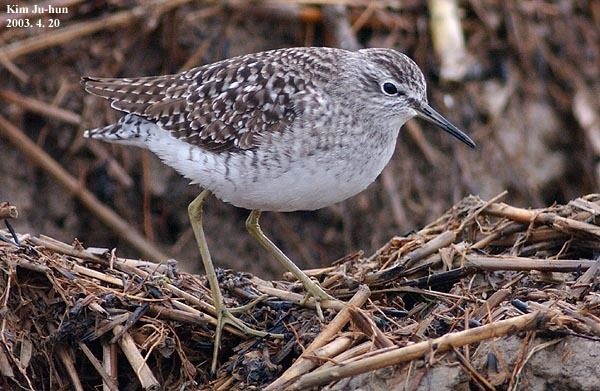
Photo: Kim, Hyun-tae · CC BY 4.0 (May be cropped or resized)
Tringa glareola
Basic stats
Diet
Invertebrates
Habitat
Boggy forests and open northern wetlands when breeding; shallow freshwater wetlands at other seasons
Range
Breeds across northern Europe and Asia; winters mainly in Africa, southern Asia and Australasia
Weight
Averages about 62g
The Wood Sandpiper is the smallest of the shanks, built lightly with long yellowish legs and a fine, straight bill. Brown upperparts carry pale spotting, while the neck and breast are softly streaked. In flight it shows a modest white rump patch rather than the stronger contrast of the Green Sandpiper. Its slim proportions and buoyant movement distinguish it from heavier wetland waders. The species averages about 62 g (Wikipedia, general species account; AVONET, Tobias et al. 2022).
Across northern Europe and Asia, the species breeds around bogs and wet ground, often in open woodland rather than on maritime coasts. It migrates long distances to Africa, southern Asia and Australasia, using shallow freshwater marshes, pools and flooded ground along the way and in winter. Feeding takes place at the water's edge or in soft mud, where birds pick and probe for invertebrates. The diet is entirely invertebrate in the EltonTraits dataset (Wikipedia, general species account; EltonTraits, Wilman et al. 2014).
Where to see Wood Sandpiper in Romania
GBIF records grouped by protected area. They show where the species has been reported, not that it is there now, and they are not population counts.
Recorded in 9 protected areas (1971–2026). The 8 with the most records:
- Danube Delta Biosphere Reserve: 1,243 records (1971–2026)
- Balta Albă - Amara - Jirlău: 61 records (2012–2026)
- Letea Forest: 8 records (1994–2023)
- Mestecănișul de la Reci și Bălțile de la Ozun-Sântionlunca: 7 records (2023–2026)
- Parcul Natural Comana: 5 records (2016–2024)
- Rezervația Naturală Roșca-Buhaiova: 5 records (2018–2024)
- National Park Munții Măcinului: 4 records (2010–2018)
- Iron Gates Natural Park: 3 records (2022)
Quick answers
- What does the Wood Sandpiper eat?
- Invertebrates
- What habitat does the Wood Sandpiper live in?
- Boggy forests and open northern wetlands when breeding; shallow freshwater wetlands at other seasons
- Where is the Wood Sandpiper found?
- Breeds across northern Europe and Asia; winters mainly in Africa, southern Asia and Australasia
- How much does the Wood Sandpiper weigh?
- Averages about 62g