
 Wildlife
of Romania
Pond Myotis
Bats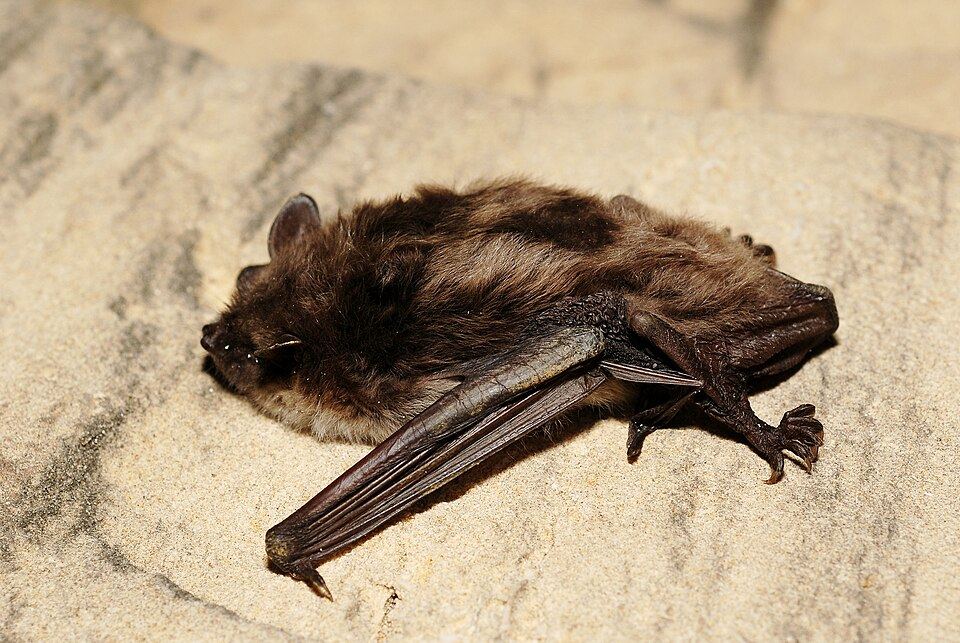
Photo: Gilles San Martin from Namur, Belgium · CC BY-SA 2.0 (May be cropped or resized)
Myotis dasycneme
Basic stats
Habitat
Lowland water edges, meadows and woods; summer roofs and church towers
Range
Eurasia, from France to Russia and Kazakhstan
Litter size
One
Size
Head and body 57–68mm
Weight
13–18g
The pond bat is a medium-sized vesper bat in the family Vespertilionidae, with a head and body of 57–68mm, a tail of 46–51mm and a forearm of 43–49mm. Its tragus is noticeably short for a Myotis. Its fur is shaggy and thick, dark brown at the base, with brownish or yellowish-grey fur on the back and white-grey or yellow-grey fur below. Its ears are relatively short and its feet are large and strong, with long bristles. It weighs 13–18g (Wikipedia, general species account; GBIF description, Vespertilionidae).
It is found across Eurasia from France to Russia and Kazakhstan. It is almost always tied to water, such as canals, slow broad rivers, lakes and ponds, and ranges from sea level up to about 1500m. In summer it lives in lowland meadows and forests and moves to the foothills in autumn and winter. Summer nursery roosts are usually in buildings such as attics and church steeples, and occasionally in hollow trees or nest boxes. Females become sexually mature in their second year, mating begins in late August, and nursery roosts form the following May. Its echolocation calls are frequency-modulated signals lasting 5–8 milliseconds (Wikipedia, general species account; GBIF description, Vespertilionidae).
Quick answers
- What habitat does the Pond Myotis live in?
- Lowland water edges, meadows and woods; summer roofs and church towers
- Where is the Pond Myotis found?
- Eurasia, from France to Russia and Kazakhstan
- What is the litter size of the Pond Myotis?
- One
- How big is the Pond Myotis?
- Head and body 57–68mm
- How much does the Pond Myotis weigh?
- 13–18g