
 Wildlife
of Romania
Natterer's Myotis
Bats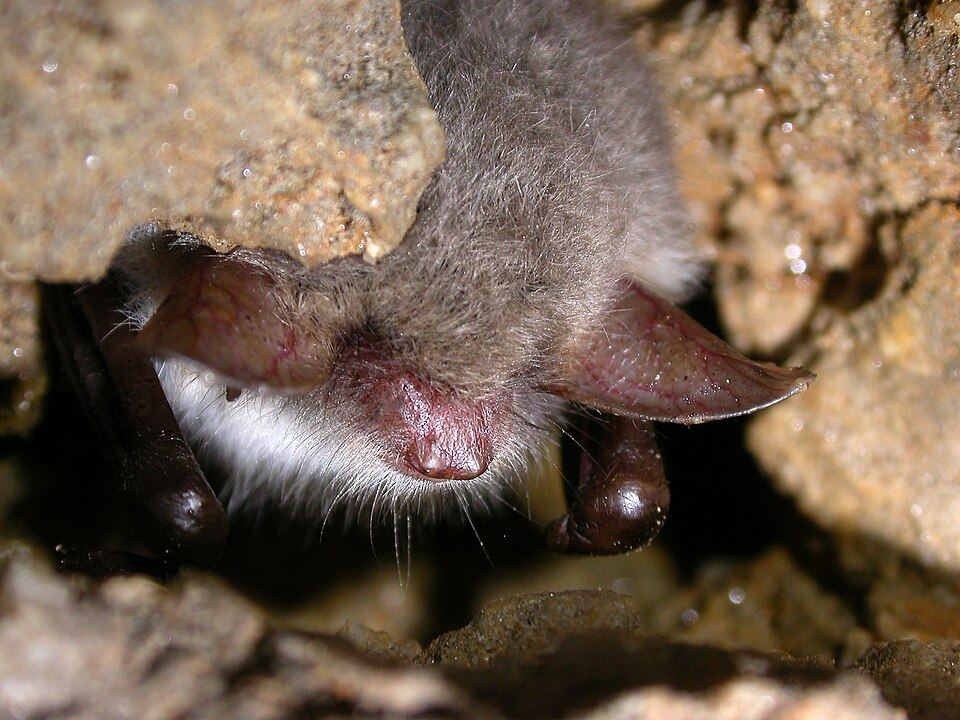
Photo: Gilles San Martin from Namur, Belgium · CC BY-SA 2.0 (May be cropped or resized)
Myotis nattereri
Basic stats
Diet
Insects and other invertebrates caught on the wing or on the ground
Habitat
Forests, parkland and open countryside with scattered woodland
Range
Most of Europe, parts of the Near East and North Africa
Litter size
1
Size
Head and body 44–51mm; forearm 34–44mm
Weight
7–10g
Natterer's bat (Myotis nattereri) is a medium-sized European vesper bat. Its short, dense dorsal fur is greyish-brown, its underside is whitish-grey, and its ears and wing membranes are smoky grey. It has a head and body length of 44–51mm, a forearm of 34–44mm and weighs 7–10g. It can be separated from similar species by the wrinkled, stiffly fringed free edge of its tail membrane and by an S-shaped calcar, the cartilage spur that supports that membrane (Wikipedia, general species account).
It is found across most of Europe, parts of the Near East and North Africa, from sea level up to about 2000m. It lives in forests, parkland and open countryside with scattered woodland, and it is largely resident, with summer and winter roosts usually within 120km of each other. In summer it roosts in tree holes, buildings and nestboxes near its feeding grounds, and in winter it hibernates in caves, tunnels, mines and cellars. Maternity colonies of 20–50 adult females and young form in tree holes, rock crevices or bat boxes. Births come in early June to early July, young fly after about 20 days, and each female has one young per year (Wikipedia, general species account; GBIF description, Vespertilionidae).
Quick answers
- What does the Natterer's Myotis eat?
- Insects and other invertebrates caught on the wing or on the ground
- What habitat does the Natterer's Myotis live in?
- Forests, parkland and open countryside with scattered woodland
- Where is the Natterer's Myotis found?
- Most of Europe, parts of the Near East and North Africa
- What is the litter size of the Natterer's Myotis?
- 1
- How big is the Natterer's Myotis?
- Head and body 44–51mm; forearm 34–44mm
- How much does the Natterer's Myotis weigh?
- 7–10g