
 Wildlife
of Romania
Greater White-fronted Goose
Ducks, Geese & Swans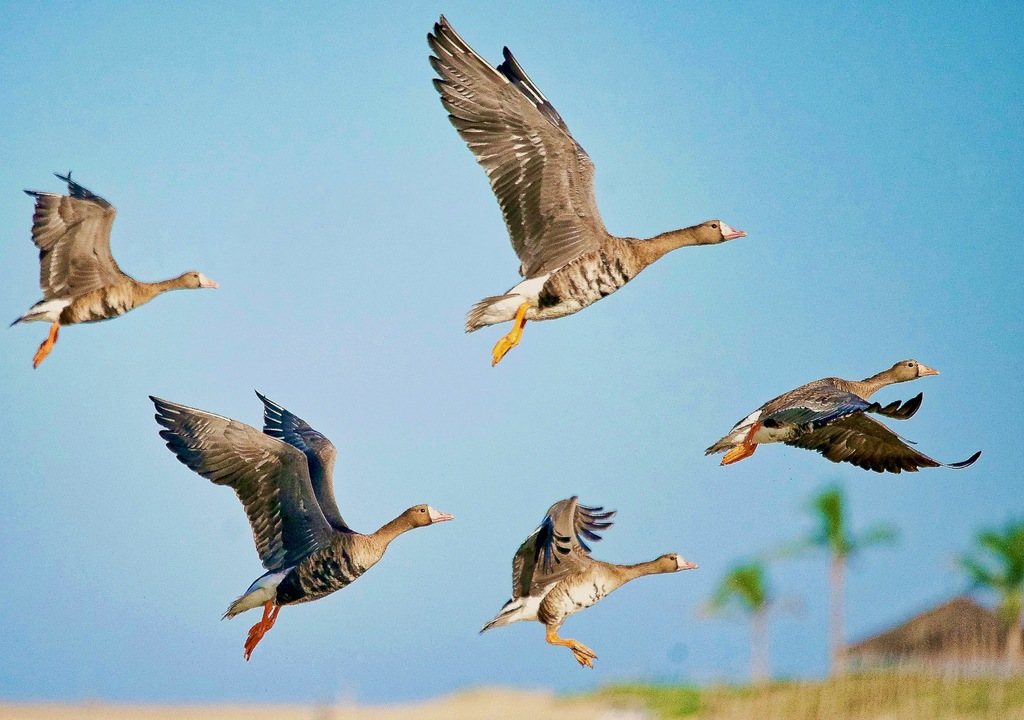
Photo: (c) Bill Levine, some rights reserved (CC BY) · CC-BY (May be cropped or resized)
Anser albifrons
Basic stats
Diet
Grasses and other plant material
Habitat
Arctic tundra when breeding; grassland, farmland, marshes and lakes in winter
Range
Breeds across Arctic Eurasia and North America; winters in temperate Eurasia and North America
Clutch size
Usually about 5 eggs
Incubation period
About 27 days
Size
64–81cm
Wingspan
130–165cm
Weight
Averages about 2506g
The Greater White-fronted Goose is a medium-sized grey-brown goose with orange legs, a pale bill and a white patch surrounding the bill base. Adults also develop irregular black bars across the belly; young birds lack both the white forehead and bold abdominal markings. In flight it shows broad wings and a pale rump. The species measures roughly 64–81 cm, spans 130–165 cm and averages about 2,506 g (Wikipedia, general species account; AVONET, Tobias et al. 2022).
Across Arctic Eurasia and North America, the species breeds on tundra near wetlands and migrates to temperate grassland, farmland, marshes and lakes. Flocks graze on grasses and other vegetation, with plant matter overwhelmingly dominant in EltonTraits. Pairs form enduring bonds, and the nest is a lined ground scrape near water. A typical clutch contains about five eggs, with incubation averaging 27 days; family groups remain together during migration and into the winter (Wikipedia, general species account; EltonTraits, Wilman et al. 2014; AnAge).
Where to see Greater White-fronted Goose in Romania
GBIF records grouped by protected area. They show where the species has been reported, not that it is there now, and they are not population counts.
Recorded in 4 protected areas (1994–2025).
- Danube Delta Biosphere Reserve: 204 records (1994–2024)
- Balta Albă - Amara - Jirlău: 48 records (2014–2024)
- Mestecănișul de la Reci și Bălțile de la Ozun-Sântionlunca: 7 records (2022–2025)
- Văcărești Nature Park: 3 records (2022–2024)
Quick answers
- What does the Greater White-fronted Goose eat?
- Grasses and other plant material
- What habitat does the Greater White-fronted Goose live in?
- Arctic tundra when breeding; grassland, farmland, marshes and lakes in winter
- Where is the Greater White-fronted Goose found?
- Breeds across Arctic Eurasia and North America; winters in temperate Eurasia and North America
- How many eggs does the Greater White-fronted Goose lay?
- Usually about 5 eggs
- How long are the eggs of the Greater White-fronted Goose incubated?
- About 27 days
- How big is the Greater White-fronted Goose?
- 64–81cm
- What is the wingspan of the Greater White-fronted Goose?
- 130–165cm
- How much does the Greater White-fronted Goose weigh?
- Averages about 2506g