 Wildlife
of Romania
Great Reed Warbler
Warblers & Kinglets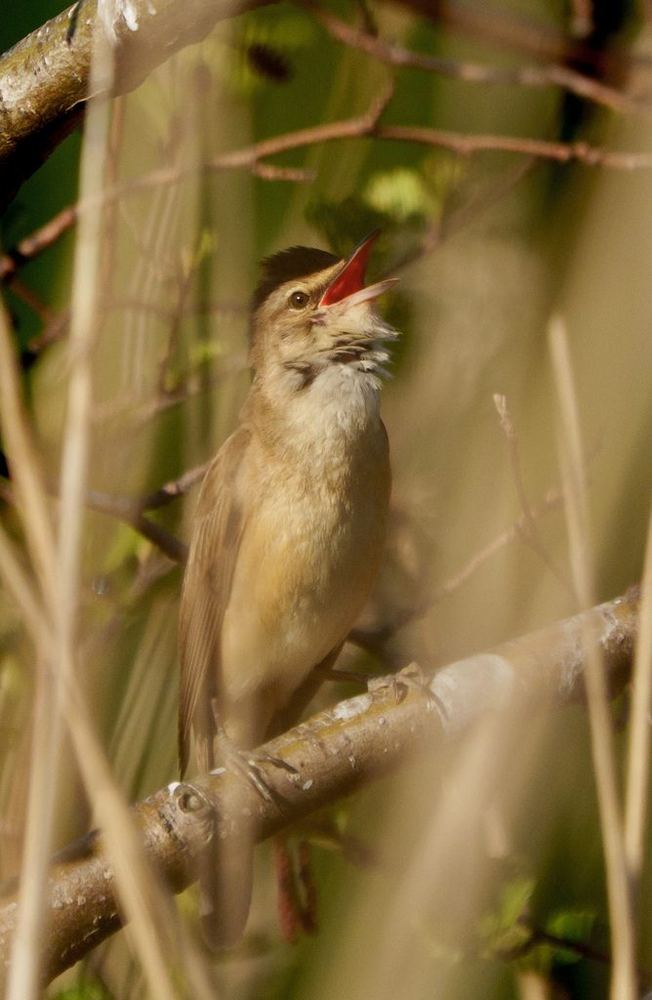
Photo: MATVEY KALACHEV · CC BY 4.0 (May be cropped or resized)
Acrocephalus arundinaceus
Basic stats
Diet
Mostly invertebrates, with small vertebrates
Habitat
Reedbeds, thickets, rice fields and wetland clearings
Range
Breeds across Europe and the western Palearctic; winters in sub-Saharan Africa
Size
16–21cm
Wingspan
25–30cm
Weight
Averages about 30g
The Great Reed Warbler is a large, thrush-sized warbler, 16–21 cm long with a 25–30 cm wingspan and an average mass of 30 g. Adults have plain brown upperparts, dull buff-white underparts, a flattened forehead, strong pointed bill and distinct eyebrow. The sexes look alike, while juveniles are warmer buff below (Wikipedia, general species account; AVONET, Tobias et al. 2022).
It breeds in extensive reedbeds across Europe and the western Palearctic and winters in sub-Saharan Africa, where reedbeds, thickets, rice fields and forest clearings are used. Birds take insect larvae, moths, dragonflies, beetles and spiders; small fish, frogs and other vertebrates also make a substantial contribution. Territorial males deliver a loud, carrying mixture of croaks, chatter, whistles and imitations (Wikipedia, general species account; EltonTraits, Wilman et al. 2014).
Where to see Great Reed Warbler in Romania
GBIF records grouped by protected area. They show where the species has been reported, not that it is there now, and they are not population counts.
Recorded in 7 protected areas (1971–2026).
- Danube Delta Biosphere Reserve: 1,209 records (1971–2026)
- Balta Albă - Amara - Jirlău - Lacul Sărat Câineni: 57 records (2012–2024)
- Văcărești Nature Park: 33 records (2016–2026)
- Parcul Natural Comana: 21 records (2016–2024)
- National Park Munții Măcinului: 5 records (2012–2023)
- Rezervația Naturală Roșca-Buhaiova: 4 records (2021–2024)
- Balta Mică a Brăilei: 3 records (2023–2025)
Quick answers
- What does the Great Reed Warbler eat?
- Mostly invertebrates, with small vertebrates
- What habitat does the Great Reed Warbler live in?
- Reedbeds, thickets, rice fields and wetland clearings
- Where is the Great Reed Warbler found?
- Breeds across Europe and the western Palearctic; winters in sub-Saharan Africa
- How big is the Great Reed Warbler?
- 16–21cm
- What is the wingspan of the Great Reed Warbler?
- 25–30cm
- How much does the Great Reed Warbler weigh?
- Averages about 30g