
 Wildlife
of Romania
Elaphe quatuorlineata
Colubrid Snakes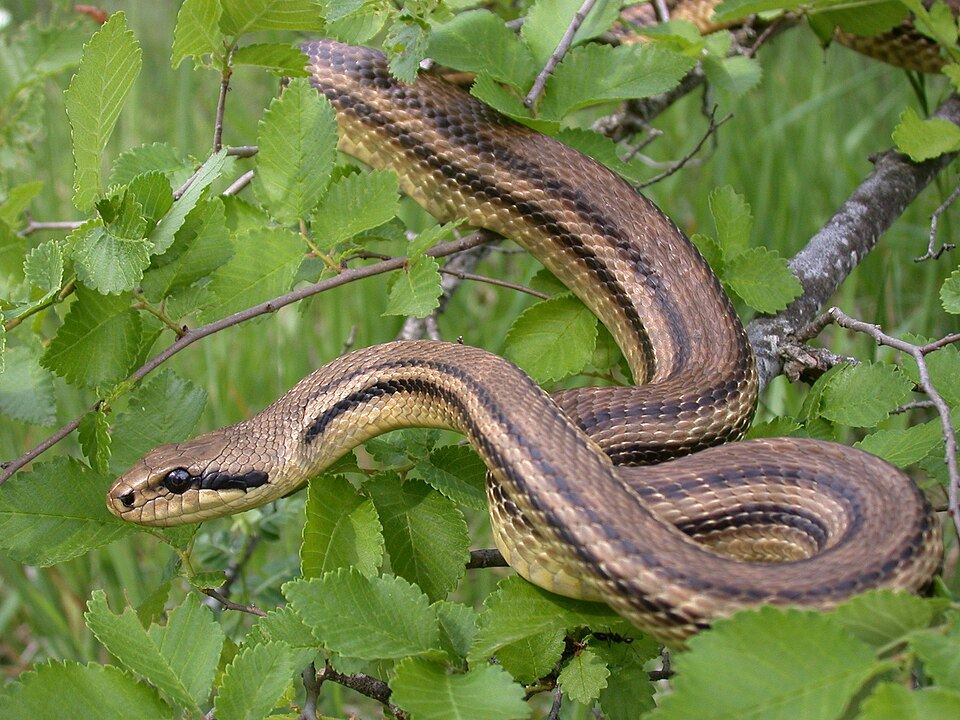
Photo: Carlo Catoni · CC BY-SA 2.5 (May be cropped or resized)
Elaphe quatuorlineata
Basic stats
Diet
Small mammals such as rabbits, weasels, squirrels and mice; also birds, lizards, young tortoises and eggs
Habitat
Mediterranean-climate areas with vegetation, stone walls, sparse woodland, forest margins and abandoned buildings
Range
Italy and the western Balkans, western Greece and many Greek islands, with Bulgaria and North Macedonia
Clutch size
6 to 18 eggs
Size
Up to 180cm, rarely 200cm
The four-lined snake, also called the Bulgarian ratsnake, is a non-venomous colubrid and one of the largest European snakes. Adults have four dark stripes along a yellowish-brown body, which gives the name, and a black line from the corner of the eye. The belly is cream to white with darker marks. Juveniles instead have a row of dark brown blotches with alternating spots on the sides on a pale brown background. Adults reach 180cm, rarely 200cm.
It favours Mediterranean climates and is found among vegetation, stone walls, sparse woodland and old buildings. In winter, groups of four to seven shelter in disused rodent burrows. It is calm, seldom hissing or striking, usually active in the morning and late afternoon, and an excellent climber. It eats small mammals, birds, lizards and eggs, and females take birds more than males do. Mating is in April and May and females lay 6 to 18 eggs in summer, incubated for 40 to 60 days (Wikipedia, general species account).
Quick answers
- What does the Elaphe quatuorlineata eat?
- Small mammals such as rabbits, weasels, squirrels and mice; also birds, lizards, young tortoises and eggs
- What habitat does the Elaphe quatuorlineata live in?
- Mediterranean-climate areas with vegetation, stone walls, sparse woodland, forest margins and abandoned buildings
- Where is the Elaphe quatuorlineata found?
- Italy and the western Balkans, western Greece and many Greek islands, with Bulgaria and North Macedonia
- How many eggs does the Elaphe quatuorlineata lay?
- 6 to 18 eggs
- How big is the Elaphe quatuorlineata?
- Up to 180cm, rarely 200cm