
 Wildlife
of Romania
Brant
Ducks, Geese & Swans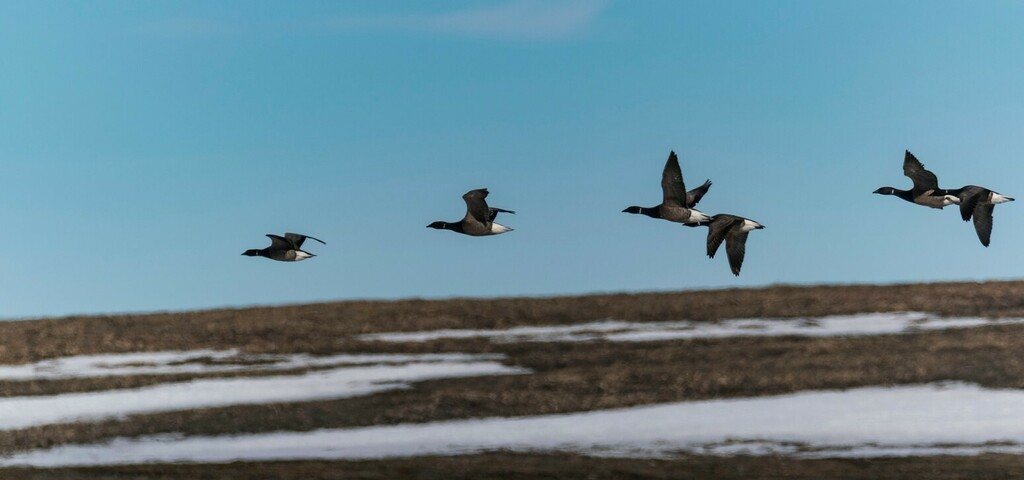
Photo: (c) Алексей Логинов, some rights reserved (CC BY) · CC BY 4.0 (May be cropped or resized)
Branta bernicla
Basic stats
Diet
Aquatic and terrestrial plants
Habitat
Arctic tundra in summer; temperate coasts and estuaries in winter
Range
High Arctic breeding grounds and temperate Northern Hemisphere coasts
Clutch size
3–5 eggs
Incubation period
23–24 days
Size
55–66cm
Wingspan
106–121cm
Weight
Averages about 1278g
The Brant is a compact goose, 55–66 cm long with a 106–121 cm wingspan. Its short bill, black head and neck, tiny white neck patches and very short black tail are shared across three geographically variable forms. AVONET records an average mass of about 1,278 g and classifies it as a strongly migratory terrestrial herbivore (Wikipedia, general species account; AVONET, Tobias et al. 2022).
All populations nest on high-Arctic tundra and winter beside temperate coasts, especially estuaries. Eelgrass, green algae and saltmarsh vegetation are major winter foods; grasses, forbs and mosses are eaten during breeding. Other plant matter makes up the entire EltonTraits diet profile. A ground nest near water usually holds three to five eggs, which hatch after 23–24 days of incubation (Wikipedia, general species account; EltonTraits, Wilman et al. 2014).
Quick answers
- What does the Brant eat?
- Aquatic and terrestrial plants
- What habitat does the Brant live in?
- Arctic tundra in summer; temperate coasts and estuaries in winter
- Where is the Brant found?
- High Arctic breeding grounds and temperate Northern Hemisphere coasts
- How many eggs does the Brant lay?
- 3–5 eggs
- How long are the eggs of the Brant incubated?
- 23–24 days
- How big is the Brant?
- 55–66cm
- What is the wingspan of the Brant?
- 106–121cm
- How much does the Brant weigh?
- Averages about 1278g